
Smith AI Pricing: What a Solo Trade Really Pays
Key takeaways
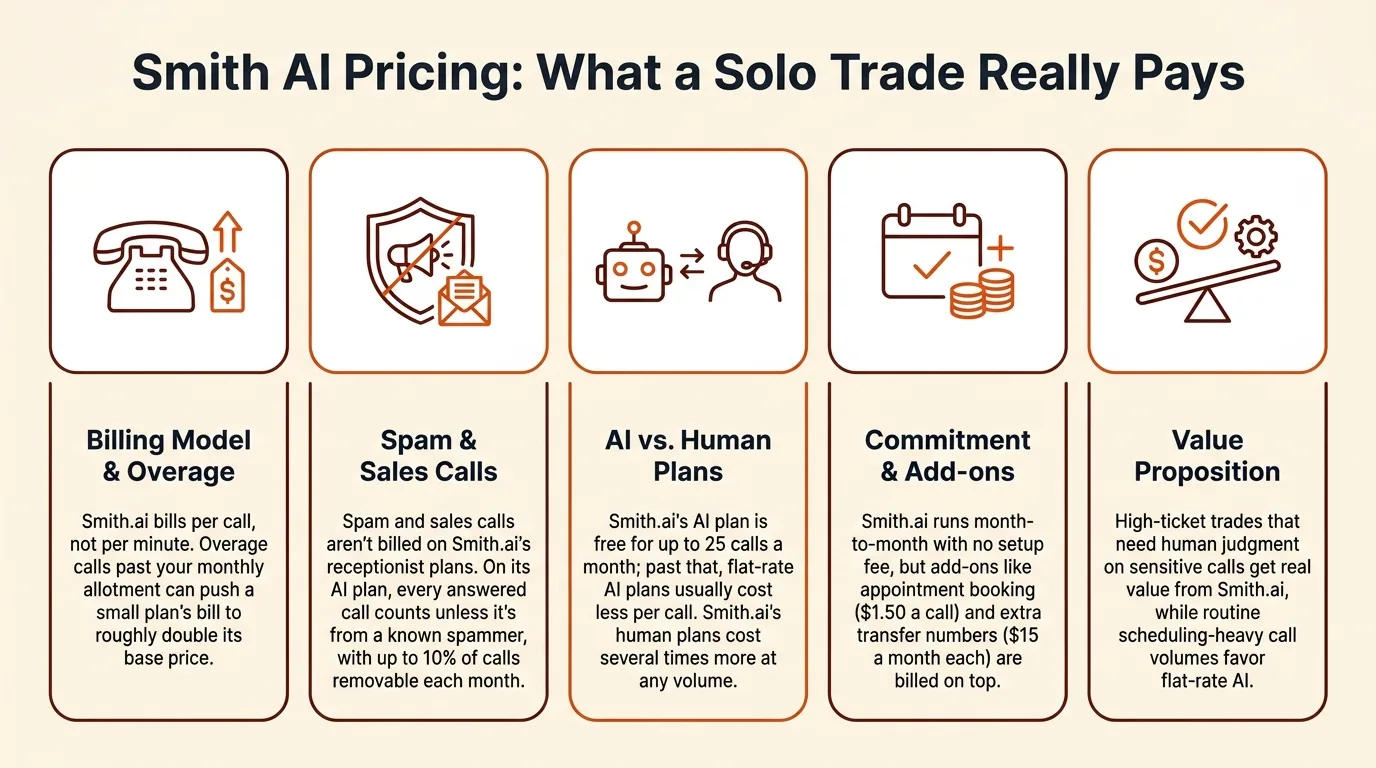
- Smith.ai bills per call, not per minute, and overage calls past your monthly allotment can push a small plan's bill to roughly double its base price.
- Spam and sales calls aren't billed on Smith.ai's receptionist plans; on its AI plan, every answered call counts unless it's from a known spammer, with up to 10% of calls removable each month.
- Smith.ai's AI plan is free for up to 25 calls a month; past that, flat-rate AI plans usually cost less per call, and Smith.ai's human plans cost several times more at any volume.
- Smith.ai runs month-to-month with no setup fee, but add-ons like appointment booking ($1.50 a call) and extra transfer numbers ($15 a month each) are billed on top.
- High-ticket trades that need human judgment on sensitive calls get real value from Smith.ai, while routine scheduling-heavy call volumes favor flat-rate AI.
Smith.ai pricing starts at $300 per month for 30 calls answered by live receptionists, then charges $11.50 for each extra call, so a busy plumber or HVAC owner can easily double that bill in a heavy month. Its AI Receptionist costs less: free for up to 25 calls a month, then plans from $150 for 75 calls. This piece runs the math at 50, 200, and 500 calls, including add-ons, and shows where a flat-rate AI receptionist comes out ahead.
Smith AI pricing: what you actually pay in 2026
Smith.ai sells two kinds of answering: plans staffed by human receptionists and AI-only plans. Both are billed per call, not per minute, and overage calls are charged at a per-call rate once you pass your monthly allotment. Smith.ai's pricing page lists them: live-receptionist plans are $300 a month for 30 calls, $810 for 90 and $2,100 for 300, with extra calls at $11.50, $10.50 and $8.50 (10% off if you commit for 12 months). The AI Receptionist is free for 25 calls a month ($3 per extra call), then $150 a month for 75 calls and $500 for 300.
Starter vs. Basic vs. Pro
The Starter plan covers 30 calls a month; Basic (90 calls) and Pro (300 calls) include more calls at a lower overage rate, and Enterprise is custom. The trade-off is simple: bigger tiers lower your per-call rate but raise the fixed monthly bill.
| Plan | Best fit | Each extra call |
|---|---|---|
| Starter: $300/mo, 30 calls | Solo trade, low volume | $11.50 |
| Basic: $810/mo, 90 calls | 2-3 tech crews | $10.50 |
| Pro: $2,100/mo, 300 calls | High after-hours volume | $8.50 |
Human receptionist plans vs. AI-only plans
Human plans cost more per call because people answer. AI-only plans answer everything automatically, closer to what SaaSyVoice does at flat rates. The next section shows how overages inflate the effective bill.
How do Smith.ai per-call overages change your effective monthly bill?
Smith.ai's plans include a set number of calls. Go past that and every extra call bills at the plan's overage rate, so the price you saw at signup is a floor, not your real monthly cost.
What counts as a billable call
It depends on the plan. On the live-receptionist plans, Smith.ai doesn't charge for spam or unsolicited sales calls, as long as your forwarded calls pass caller ID. On the AI Receptionist, every answered call counts by default: calls from known spammers are filtered out for free and you can remove up to 10% of your calls from each bill, but a week of new robocalls still eats into your plan.
Why a 'cheap' plan can double in a busy month
Say you're on the $300 Starter plan (30 calls) and get 60 calls in a spring HVAC season. The 30 extra calls bill at $11.50 each, adding $345, so the month costs $645, more than double the plan price.
Per-call billing punishes exactly the months you're busiest. Flat plans, like the ones on our pricing page, have no per-call or per-minute overage: a busy month means adding a minute pack or moving up a plan, not a surprise bill.
What setup, integration, or add-on fees does Smith.ai charge?
The listed tier price is not always the whole bill. Smith.ai documents several extras that add one-time or recurring charges, so ask about them before you sign up.
Onboarding and setup
Good news here: Smith.ai's pricing page says there are no setup fees on its receptionist plans, and its paid AI plans include onboarding setup. Budget your time instead: your scripts, service area and job types still need writing up before calls go live.
CRM and booking integrations
On the receptionist plans, your first CRM connection is free, each extra CRM adds $0.50 a call, booking appointments adds $1.50 a call, and custom calendaring adds $1.00 a call. On the AI Receptionist, scheduling (Calendly and similar) and native integrations are included, and custom integrations need the Enterprise plan.
Warm transfer and message-delivery extras
On the receptionist plans, Starter, Basic and Pro include 1, 2 and 10 transfer numbers, with more at $15 a month each, and a text or Slack alert when a caller qualifies for a transfer costs $0.50. On the AI Receptionist, handing a call to a live agent costs $3.00 extra, per Smith.ai's help center.
Flat-rate options price differently: SaaSyVoice builds your AI receptionist from your website in about a minute with no setup fee, and we break down how it compares to Goodcall on our site.
How much does Smith.ai cost at 50, 200, and 500 calls per month?
Scenario 1: 50 calls/month solo operator
At 50 calls a month, the $300 Starter receptionist plan covers 30, and the other 20 bill at $11.50 each: $530 for the month, before add-ons like appointment booking. Smith.ai's AI Receptionist handles the same 50 calls for about $75 on its free tier (25 calls free, then $3 a call). For comparison, 50 calls of about three minutes fit inside SaaSyVoice's $79 Solo plan (300 minutes).
Scenario 2: 200 calls/month small crew
At 200 calls, the receptionist plans get expensive: Basic is $810 for 90 calls plus 110 extra calls at $10.50, about $1,965 a month. On the AI Receptionist, the 150-call tier ($270) plus 50 extra calls at $2.30 comes to about $385. On SaaSyVoice, 200 calls of about three minutes fit inside the $199 Business plan (800 minutes).
Scenario 3: 500 calls/month high-volume shop
At 500 calls, the receptionist Pro plan is $2,100 for 300 calls plus 200 extra at $8.50, about $3,800 a month, and the AI Receptionist's 500-call tier is $800. On SaaSyVoice, 500 calls of about three minutes fit inside the $449 Multi-location plan (2,000 minutes). Whether any of it is good value depends on how many calls turn into booked jobs, not on the raw count.
The break-even point vs. flat-rate pricing
Here is the math per call, using the prices above. Smith.ai's receptionist plans work out to about $7 to $11.50 a call, and its AI Receptionist to about $1.60 to $3 a call once you pass the free 25. SaaSyVoice's plans work out to about $0.75 to $1.45 a call at three minutes a call (Basic is $29 for about 20 calls, Solo $79 for about 100, Business $199 for about 250), and calls of 30 seconds or less don't use minutes. The catch: SaaSyVoice counts minutes, not calls, so long calls use more of your plan.
The pattern matters more than any single figure: per-call pricing tracks your growth call for call, while a flat plan stays put until you outgrow its minutes. Against Smith.ai's receptionist plans there's no crossover at all, since a flat AI plan costs less at every volume; against its AI Receptionist, the free 25 calls make Smith.ai cheaper for a very quiet line, and flat pricing pulls ahead from around 50 calls a month. If you run an electrical shop, our page for electricians shows how the AI handles your calls, and our pricing page shows how many calls each plan covers. Where SaaSyVoice falls short: a human answering service like Ruby Receptionists still handles judgment calls better than any AI, and if that matters more to you than price, per-call pricing may be worth the premium.
At what call volume does a flat-rate AI answering service beat Smith.ai on price?
Because Smith.ai bills per call and flat-rate services bill per month, the crossover is simple math: multiply your average monthly calls by the effective per-call rate, and compare it against a flat monthly fee. Once your bill would exceed that flat fee, flat-rate wins.
Flat-rate vs. per-call at 50/200/500 calls
At 50 calls a month, Smith.ai's AI Receptionist (about $75 on its free tier) and a flat AI plan like SaaSyVoice's Solo ($79) cost about the same, while Smith.ai's receptionist plans cost several times more. At 200 calls, flat pricing is well ahead ($199, against about $385 for Smith.ai's AI and about $1,965 for its receptionists), and by 500 calls the gap is wider still. SaaSyVoice runs $29–$449 a month with no per-minute overage: a heavy month means adding a minute pack or moving up a plan, never a surprise bill. Before you switch, check Smith.ai's cancellation terms: its receptionist plans are month-to-month, and its AI Receptionist asks for 30 days' notice to cancel.
Where per-call still makes sense
If your calls are seasonal, sporadic, or mostly spam you don't want counted, paying per call keeps your bill low. After-hours overflow is a common pattern for trades — see how after-hours answering handles it without a full-time plan.

How does Smith.ai's per-call pricing compare to flat-rate competitors?
Per-call vs. per-minute vs. flat-rate models
Smith.ai charges per call, so your bill moves with your volume. A slow month costs less; a burst of calls after a storm costs more, and overages push the effective rate up. Goodcall charges a monthly fee by the number of unique callers (from $79 for 100), Rosie sells monthly minute bundles (from $49 for 250 minutes), PATLive sells live-agent minute bundles (from $99 for 50 minutes), and Ruby leans premium with human receptionists (from $250 for 50 minutes). SaaSyVoice uses flat monthly plans from $29 (60 minutes) to $449 (2,000 minutes) with no per-minute overage, so a busy month never brings a surprise bill.
Which model fits which business
Per-call makes sense if your volume is genuinely low and unpredictable, and you want humans handling calls, which is Smith.ai's strength. Flat-rate wins once calls become steady: if you already know you get 150+ calls a month, a fixed bill is easier to budget and cheaper at the top end. Honest caveat on our own product: an AI receptionist handles routine capture and booking well, but it will not match a trained human on nuanced or sensitive calls. If that matters most to you, Smith.ai or Ruby justify their pricing.
What is Smith.ai's contract, cancellation, and refund policy?
Smith.ai runs month-to-month with no long-term contract. Its receptionist plans can be canceled any time; its AI Receptionist asks for 30 days' notice. Smith.ai offers rollover calls only as part of a 6-month AI Receptionist plan, so ask before assuming unused calls carry over. If a sales rep offers an annual commitment, treat it like any discount: you save per month but hand back flexibility if your call volume drops or the service disappoints.
Refund and trial terms
Smith.ai's receptionist plans come with a 30-day money-back guarantee (refunds up to $1,000, overage not included), and its AI Receptionist has a free tier of 25 calls a month instead of a trial. Compare that against other options: Goodcall lets you build a free demo agent and pay only once you connect a number, and SaaSyVoice has a free 14-day trial with no card.
Is Smith.ai worth it for a solo trade or appointment-based business?
When Smith.ai earns its price
If you bill $1,500+ per job and lose even one after-hours call a month to a competitor, a human-backed service pays for itself. Smith.ai's hybrid of people plus software handles warm transfers and judgment calls an AI alone can miss. High-ticket trades with complex scheduling get real value here.
When a flat-rate AI receptionist is the better buy
If most of your calls are routine — "are you open," "what's your rate," "can you come Tuesday" — paying per call is dead weight. A flat-rate AI receptionist answers all of them, books appointments, and bills no surprise overage for a busy week. At 200+ calls a month, the math stops being close.
Where SaaSyVoice falls short too
Honesty cuts both ways: we're AI-only. The AI can warm-transfer a caller to your cell, but if you can't pick up, there's no human to handle an angry caller or a weird edge case. And the first build comes from your website in about a minute, so it's only as good as your site until you add your own details. If you need a person on every call, Smith.ai or Ruby Receptionists is the safer pick. If you need every call answered and appointments booked for a flat rate, that's us.
FAQ
Does Smith.ai charge per call or per minute?
Smith.ai bills per call, not per minute, on both its human receptionist and AI-only plans. Each inbound call counts toward your monthly allotment, and once you pass it, extra calls bill at an overage rate. Because the unit is the call rather than the minute, a long call costs the same as a quick one.
Is there a Smith.ai free trial or money-back guarantee?
Smith.ai's receptionist plans include a 30-day money-back guarantee (refunds up to $1,000, overage excluded), and its AI Receptionist has a free tier of 25 calls a month. Both run month-to-month; the AI Receptionist asks for 30 days' notice to cancel.
How many minutes does the average answered call use?
Smith.ai does not bill by minutes, so average duration matters less for your invoice than the raw call count. For a typical trade business, most answered calls are short scheduling or pricing questions, with longer calls reserved for complex jobs. Your bill moves with how many calls arrive, not how long each one lasts.
Can Smith.ai book appointments directly into my calendar or job software?
Yes. On the receptionist plans, booking appointments costs $1.50 a call on top of the call itself, and each CRM after the first adds $0.50 a call. The AI Receptionist includes scheduling through tools like Calendly on every plan, and custom integrations need its Enterprise plan.
What happens if I go over my plan's call limit mid-month?
Every call past your included allotment bills at the plan's overage rate ($11.50 a call on the $300 Starter plan), so 26 extra calls double the bill. Spam and sales calls aren't billed on the receptionist plans; on the AI Receptionist, every answered call counts unless it's from a known spammer, with up to 10% of calls removable each month.