
AI That Answers Missed Calls for Plumbers and Electricians
Key takeaways
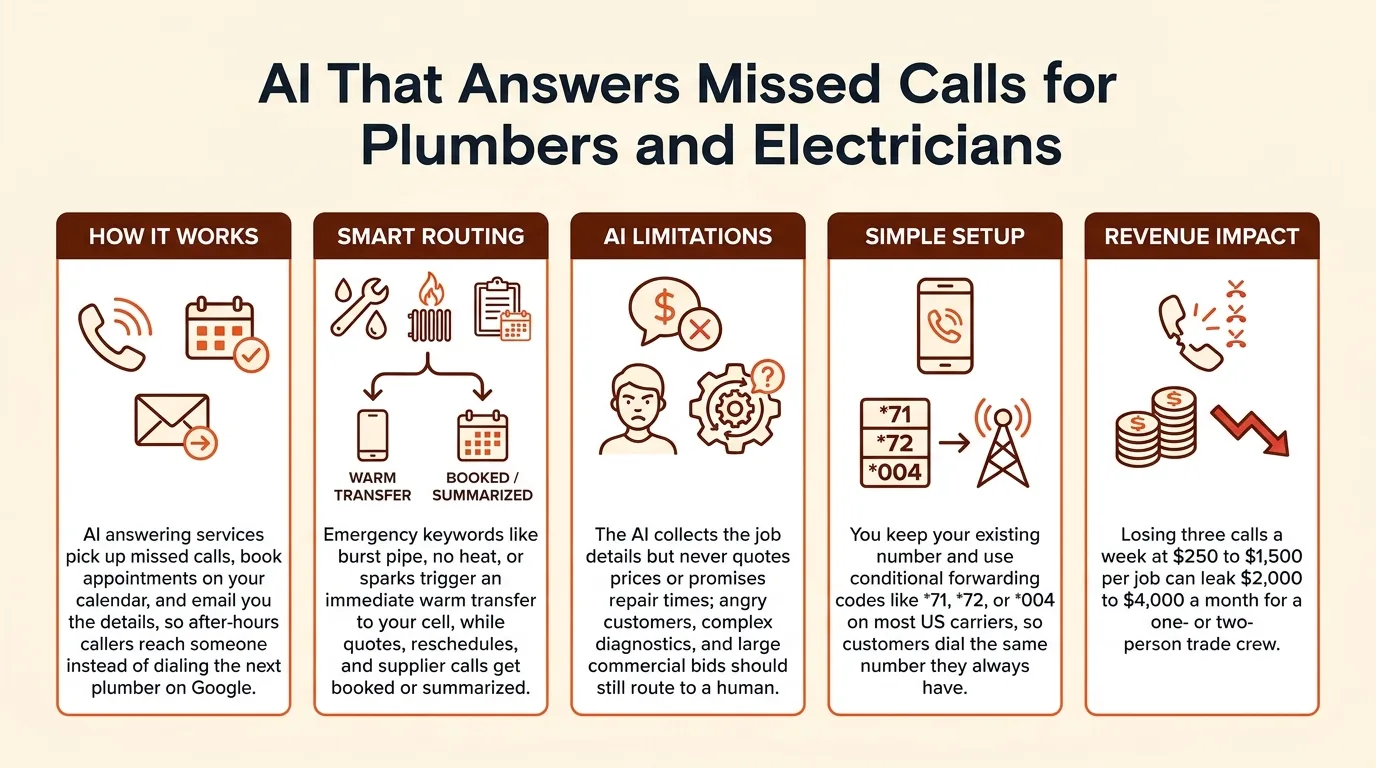
- AI answering services pick up missed calls, book appointments on your calendar, and email you the details, so after-hours callers reach someone instead of dialing the next plumber on Google.
- Emergency keywords like burst pipe, no heat, or sparks trigger an immediate warm transfer to your cell, while quotes, reschedules, and supplier calls get booked or summarized.
- The AI collects the job details but never quotes prices or promises repair times; angry customers, complex diagnostics, and large commercial bids should still route to a human.
- You keep your existing number and use conditional forwarding codes like *71, *72, or *004 on most US carriers, so customers dial the same number they always have.
- Losing three calls a week at $250 to $1,500 per job can leak $2,000 to $4,000 a month for a one- or two-person trade crew.
AI that answers missed calls for plumbers and electricians picks up when you can't, asks the caller what's wrong, books the appointment, and emails you the details. Below are example calls, written out word for word, for the four that matter most: the 2 a.m. burst pipe, the quote request, the reschedule, and the supplier call.
What does AI that answers missed calls for plumbers and electricians actually do?
It's call forwarding with a brain on the other end. You set your phone to forward missed calls to the AI, and it picks up 24/7, figures out who's calling and what they need, and books the job on your calendar. For a one-truck operation where you're under a sink with a customer's wife calling about a burst pipe, that's the difference between a booked job and a voicemail nobody checks until dinner. Missed calls are expensive in the trades: call-analytics vendors report that a large share of home-services callers who hit voicemail never call back and just dial the next plumber on Google (CallRail). SaaSyVoice builds your receptionist from your website in about a minute, keeps your existing number, and answers in the caller's language.
What happens to a missed emergency call when AI answers instead of voicemail?
The exact exchange, word for word
A burst pipe at 2 a.m. sounds like this. Caller: "My water heater burst, there's water everywhere." AI: "That sounds urgent. What's the address of the property?" Caller gives it.
AI: "Is water still flowing? If so, the shutoff valve is usually near the base of the water heater or on the main line where it enters the house. Turn it clockwise until it stops." Caller shuts it off. AI: "Got it.
This sounds like an emergency. I have a slot at 7 a.m. tomorrow, or I can connect you to the on-call tech right now. Which do you prefer?"
That exchange is the whole pitch. The AI captures the address, talks the caller through stopping the water, logs the urgency, and offers the two outcomes the owner set in advance: book the earliest slot or ring the on-call tech. If the caller picks the transfer, the AI connects the call live so the owner wakes up to a booked job, not a voicemail. The same rules apply to after-hours electrical calls, which is what SaaSyVoice's AI phone agent for electricians is built around.
What the AI does before hanging up
Before the call ends, the AI confirms the address back, sends a text with the booking time, and flags the call as an emergency in your notifications. If the owner's rules say no 2 a.m. jobs, it books first light instead and says so plainly. What it will not do is quote a price or promise a repair time. That stays with you.
How does AI handle quote requests for plumbing and electrical jobs?
A quote call sounds like this: "I need a quote on replacing a water heater." The AI asks what the caller would have been asked anyway — is it a tank or tankless, gas or electric, is the old unit still working, when do they need it done — then books an estimate slot on the calendar. If the caller asks something out of scope, like "does the panel need upgrading too," the AI flags it for the owner instead of guessing. This matters because most callers who hit voicemail never leave a message, and after-hours callers are the least likely to try again — behavior documented by answering services like Ruby. SaaSyVoice runs the same play on every missed quote call, and if a caller hangs up before it finishes, its missed-call recovery emails you their number so you can call back.
What AI can quote and what it can't
The AI can collect the details and put the estimate on the calendar. It cannot price the job. Scope surprises, old-house weirdness, and "while you're here" additions still need your judgment — the AI's job is making sure the lead is booked on your calendar, with the call summary in your inbox, when you look.
Can AI scheduling capture jobs a plumber would lose after hours?
Yes, if the AI can see your calendar and write to it. A 9 p.m. call about a water heater that "keeps going cold" becomes a booked 8 a.m. slot before you've hung up your wrench. The caller states the problem, the AI checks open times, confirms the morning appointment, and emails you both the details.
Reschedules work the same way. A customer calls at 7 p.m. to push a Tuesday job, the AI moves it to Thursday and fills the gap if another caller grabs the old slot.
No-show reminders run off the same calendar: a morning text confirming today's appointment cuts down on empty drive time.
Where it falls short: the AI books the slot, but it can't judge that a "small leak" is actually a slab leak needing a same-day squeeze-in. You still review the morning's bookings.
That's the workflow behind SaaSyVoice's AI answering service, built to book appointments straight into your calendar around the clock.
What happens to supplier and non-customer calls?
Not every missed call is money. Supply houses, wrong numbers, and spam calls all hit the same line, and AI sorts them in seconds instead of interrupting you mid-repair.
When a supply house calls about a backordered part, the AI takes the message, notes the job or invoice number, and emails you a summary. A spam caller gets hung up on. A wrong number gets a polite goodbye. Nothing books, nothing pings your phone.
That triage is the quiet win: you only hear about calls that need you. A service like SaaSyVoice handles this filtering automatically, so a 2 p.m. robocall never costs you the same attention as an emergency call.
How do missed calls translate into lost revenue for one- and two-person trade crews?
The math is simple and ugly. When you're under a sink, you can't pick up. The caller has a burst pipe tonight, so they hang up and dial the next plumber on Google. After-hours callers almost never leave voicemail; they keep dialing until someone answers.
Run illustrative numbers: a drain replacement at $800, an emergency callout at $250, a water heater swap at $1,500. Lose three calls a week and you're leaking $2,000-$4,000 a month, before repeat business. For scale, the Bureau of Labor Statistics puts median plumber pay around $61,000 a year (BLS), so missed calls can rival a second salary.
That's the honest trade-off: AI answering isn't free, but neither is voicemail.

What call types should still route to a human in a trade business?
Four call types deserve a human, and SaaSyVoice lets you mark each as warm-transfer-only. First, angry customers: a flooded second bathroom or a breaker that tripped twice this week needs an owner's voice, not a booking confirmation. Second, complex diagnostics: "my furnace smells like burning and the breaker keeps flipping" needs follow-up questions no script covers. Third, large commercial bids, where pricing and scope conversations belong to you.
Fourth, anything you flag yourself. If a repeat customer's calls should always reach your cell, set that rule once. The honest limit: AI handles routine booking well, but it cannot talk a panicked customer off the ledge or quote a $40,000 panel upgrade. Route those to you.
How do plumbers and electricians set up call routing for emergencies vs. routine calls?
Keep your number and forward conditionally
You keep your existing number. Set conditional call forwarding so calls only reach the AI when you miss them or you're already on the phone: dial *71 (no-answer), *72 (busy), or *004 (all missed) plus your forwarding number on most US carriers. AT&T publishes these activation codes in its call forwarding support documentation, and deactivation is *73.
Then set rules in your AI tool: emergency keywords like "burst pipe," "no heat," or "sparks" trigger an immediate warm transfer to your cell. Everything else — quotes, reschedules, supplier calls — gets booked or messaged to you instead.
Test calls before you go live
Run five test calls: an after-hours emergency, a routine quote request, a call while your line is busy, a hangup, and a spam call. Confirm each booked job and email summary lands where you expect before a real customer hits it.
How do the main AI answering tools compare for trade businesses?
| Tool | Trade fit | After-hours handling | Pricing transparency |
|---|---|---|---|
| SaaSyVoice | Plumbing, HVAC, electrical built in | 24/7 booking, warm transfer | Published tiers, $29–$449 |
| Goodcall | General small business | 24/7 answering | Published pricing |
| Smith.ai | General, incl. trades | Human + AI mix | Published pricing |
| Ruby | General | Human receptionists | Quote-based |
SaaSyVoice is built around your exact problem: missed calls on a job site. You build the receptionist from your website in about a minute, it keeps your number, answers after hours, books the appointment, and there's a free trial with no credit card. Where it falls short: it's AI-only, so no human picks up mid-call, and the $29 Basic plan's 60 minutes cover about a call a day, so a busier shop needs Solo ($79, 300 minutes) or Business ($199, 800 minutes).
Goodcall and Smith.ai are solid generalists; Ruby leans human. Whichever you shortlist, compare them on price and run the same test calls before you commit.
FAQ
Will my customers know they're talking to an AI instead of a person?
Possibly, and that's mostly fine. The AI answers in a natural voice, handles the caller's language, and gets straight to the problem: what's wrong, where, and when to book. Most callers care about reaching someone at 2 a.m., not whether that someone is human. If a caller insists on a person, the AI can warm-transfer to your cell.
Can the AI tell the difference between a real emergency and a routine request?
Yes, through rules you set in advance. Keywords like burst pipe, no heat, or sparks trigger an immediate warm transfer to your on-call tech or cell. Routine calls, like quote requests or reschedules, get booked on the calendar instead. The AI logs urgency and flags emergencies in your notifications, so a 2 a.m. flood never waits behind a robocall.
Do I have to change my business phone number to use an AI answering service?
No. You keep your existing number and set conditional call forwarding so calls only reach the AI when you miss them or your line is busy. Dial *71 for no-answer, *72 for busy, or *004 for all missed calls, plus your forwarding number, on most US carriers. Your customers dial the same number they always have.
How much does an AI answering service cost for a small plumbing or electrical business?
SaaSyVoice publishes tiers from $29 to $449 per month, with a free 14-day trial and no credit card required. Goodcall and Smith.ai also publish pricing, while Ruby quotes custom rates. Weigh that against illustrative losses: three missed calls a week at $250 to $1,500 per job can leak $2,000 to $4,000 a month.
What happens if the AI can't answer a caller's question?
It flags the question for you instead of guessing. Asked whether a panel needs upgrading during a water heater quote, the AI notes it in the call summary it emails you. It also won't quote prices or promise repair times, since those need your judgment. The lead still lands on your calendar.