
24 7 Telephone Answering Service: Costs & How to Pick
Key takeaways
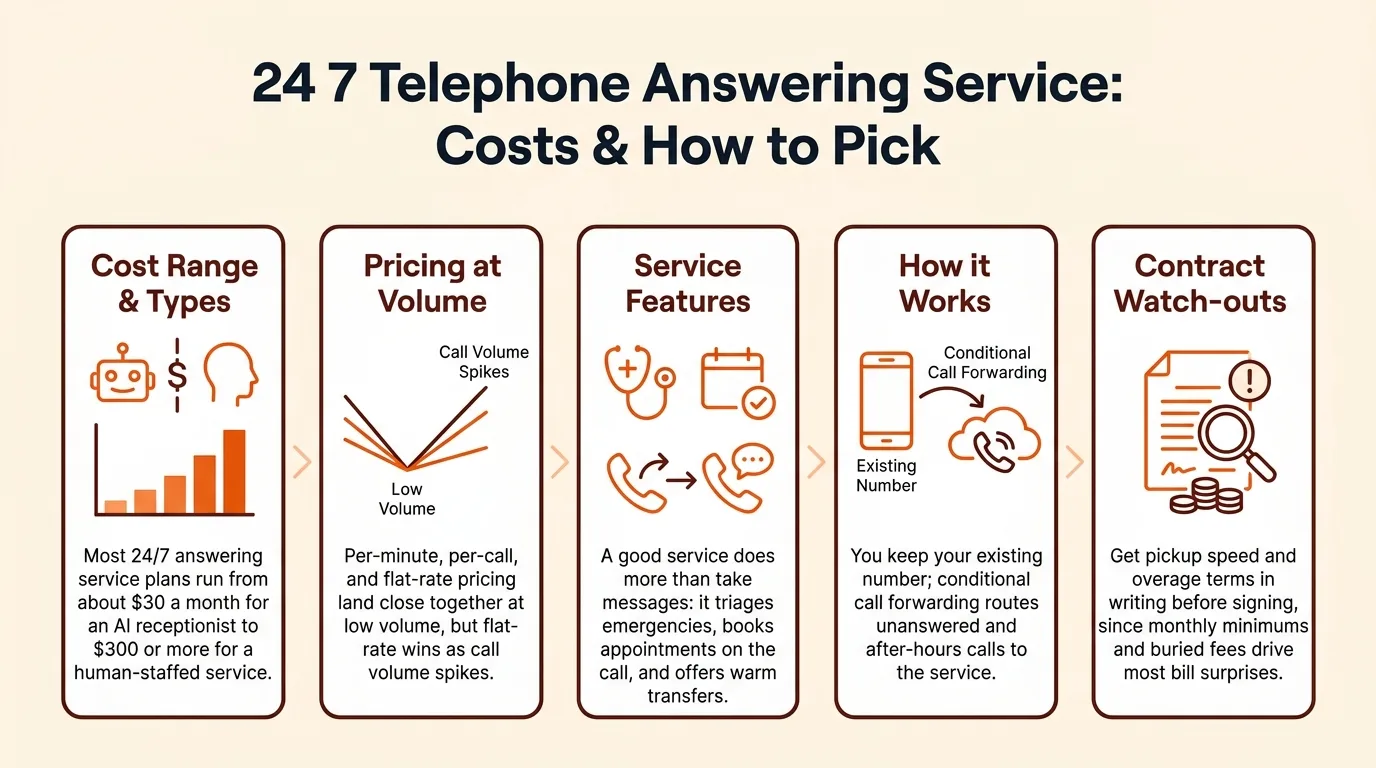
- Most 24/7 answering service plans run from about $30 a month for an AI receptionist to $300 or more for a human-staffed service.
- Per-minute, per-call, and flat-rate pricing land close together at low volume, but flat-rate wins as call volume spikes.
- A good service does more than take messages: it triages emergencies, books appointments on the call, and offers warm transfers.
- You keep your existing number; conditional call forwarding routes unanswered and after-hours calls to the service.
- Get pickup speed and overage terms in writing before signing, since monthly minimums and buried fees drive most bill surprises.
A 24 7 telephone answering service picks up every call you can't, day, night, and weekends, takes a message or books the appointment, and reaches you for anything urgent. This guide breaks down how it works call by call, what drives pricing (per-minute, per-call, monthly minimums), and how to compare quotes so a cheap plan doesn't cost you a $3,000 job.
What is a 24/7 telephone answering service and how does it work?
A 24/7 telephone answering service picks up your business line whenever you can't: on a ladder, under a sink, or at 9pm when a furnace dies. The service answers in your company's name, takes a message, answers basic questions, and can book appointments or pass urgent calls to you.
Live human agents vs AI receptionists
Human services like Smith.ai and Ruby Receptionists staff real people who follow your script. AI receptionists, like SaaSyVoice, answer instantly at any hour, in the caller's language, and book straight into your calendar. Humans handle nuance better; AI costs less and never puts a caller on hold.
How calls actually reach the service (call forwarding)
You set your phone line to forward unanswered or after-hours calls to the service's number. Your carrier handles this with conditional forwarding settings, so callers dial your usual number and never know the difference. After-hours coverage is the most common setup for trades; see how after-hours answering works.
What does a 24 hour live answering service actually handle on a call?
A 24 7 telephone answering service handles the whole call, not just taking messages. The caller hears a greeting that sounds like your business, the service captures their name, number, address, and what the job is, then either books the appointment, offers a warm transfer to you, or takes a detailed message. Here is how that plays out for a plumbing call: answering service for plumbers
Emergency triage for trades calls
The first job is sorting "my water heater is leaking" from "can you quote a remodel next month." A good service asks whether there is active water, gas smell, or no heat, and flags true emergencies so you can call back first. Everything else gets queued for normal business hours.
Booking appointments and warm transfers
For routine jobs, the service checks your calendar and books a slot on the call, so the caller hangs up with an appointment instead of waiting for a callback. If the caller insists on speaking with you, a warm transfer patches them through live or offers to have you call back.
After-hours and weekend coverage
After-hours calls are where an answering service earns its keep. The same greeting, capture, triage, and booking flow runs at 9pm on a Sunday, so a burst pipe at midnight becomes a booked job instead of a voicemail your competitor answers first.
How much does a phone answering service cost in 2026?
Most small-business plans run from about $30 a month for an AI receptionist to $300 or more for a human-run service. What you pay comes down to call volume, minutes used, and whether a person or software picks up.
Real price examples from named providers
| Provider | Model | What you get |
|---|---|---|
| Smith.ai | Per-call, monthly plans | Human agents, warm transfer, appointment booking |
| Ruby Receptionists | Per-minute, monthly plans | Live receptionists, message taking |
| Goodcall | Monthly plans, metered by unique callers | AI receptionist, 24/7 coverage |
| PATLive | Per-minute, monthly plans | Live answering, after-hours coverage |
| SaaSyVoice | Flat monthly plans, $29–$449/mo (60–2,000 minutes) | AI receptionist built from your website in about a minute, books appointments |
The cost of missing calls is the other side of the math. A single missed after-hours job, a leaking water heater or a no-heat call, can be worth hundreds to thousands of dollars to a plumber or HVAC tech, and a caller who reaches voicemail often calls the next business on the list.
One honest caveat on our own pricing: flat monthly plans like SaaSyVoice's, with no per-minute overage, keep your bill predictable, but AI handles routine booking and messages better than complex emergencies. If every call needs human judgment, a per-minute live service may fit better even at a higher monthly cost.
Restaurants and catering businesses have the same after-hours problem with reservations; see our answering service for restaurants.
Why do answering service quotes vary so much between providers?
Two services can both promise 24/7 coverage and still land $100 apart on your monthly bill. The difference usually comes down to four things: the pricing model, monthly minimums, overage rates, and setup fees. Some providers charge per minute, some per call, and some bill per unique caller, so the same call volume produces very different invoices.
Monthly minimums and overage fees
Many plans look cheap until you read the fine print. A low base rate often hides a monthly minimum, meaning you pay for minutes you never use. Go over your allowance and overage rates kick in, sometimes at a higher per-minute rate than your plan. If your call volume spikes during a heatwave or a burst-pipe cold snap, that overage clause is where your bill balloons. Usage spikes are normal in home services, so ask what happens above your cap before you sign.
Setup fees and contract terms
Setup fees range from nothing to a few hundred dollars, and some providers waive them if you commit to a longer contract. Watch for month-to-month versus annual terms, and whether you can port your number out if you leave. At SaaSyVoice, we skipped setup fees entirely: your AI receptionist builds from your website in about a minute, and plans run $29 to $449 a month. Human-staffed services cost more because per-agent staffing is their biggest expense; shared-agent pools spread that cost, which is one more reason quotes differ.
Per-minute vs per-call vs flat-rate pricing: which answering service cost model fits your call volume?
Per-minute billing charges for time on the phone, per-call billing charges a flat fee for each answered call, and flat-rate (or unlimited) plans charge one monthly price regardless of volume. The cheapest model depends entirely on how many missed calls you get and how long they run. A two-minute call costs more per minute; a one-minute "what are your hours?" call costs more per call.
Worked example: 100 calls a month under each model
Say you get 100 missed calls a month, averaging two minutes each, at typical rates of $1 per minute or $2 per call (illustrative figures; check each provider's current pricing). Per-minute: 200 minutes × $1 = $200. Per-call: 100 × $2 = $200. Flat-rate: one monthly fee, likely $150-$300, no matter what. At low volume the three land close together; at 300 calls the per-minute and per-call bills climb while flat-rate stays put.
Volume cuts the other way too. If 30 of those calls are quick price-checks that last under a minute, per-minute pricing drops your bill sharply while per-call stays fixed at $2 each. Run the math on your own call log before signing anything.
Flat monthly plans like SaaSyVoice's (from $29, with no per-minute overage; see our answering service for HVAC) suit solo owners whose call volume spikes with the season: a busy month means adding a minute pack or moving up a plan, not a surprise per-minute bill. If your volume is steady and low, per-minute pricing from a provider like PATLive may cost less. The honest caveat: flat-rate only wins if the service quality holds, which the next section covers.

Is the cheapest phone answering service worth it, or do you get what you pay for?
Sometimes, yes. If your call volume is low and your calls are simple, a bargain plan can beat voicemail. The trouble starts when the low price comes from cutting the things that actually win jobs: fast pickup, judgment on emergencies, and accurate message-taking.
Red flags in a cheap answering service quote
- Pickup speed not stated in writing. If the quote doesn't promise an answer window, assume callers sit on hold.
- Per-call pricing with tiny call allowances. A "cheap" plan that includes 30 calls a month can bill overages that cost more than a mid-tier plan.
- No emergency triage. A burst pipe at 9pm needs a warm transfer or urgent message, not a note left for morning.
- Setup or per-minute overage fees buried in the fine print.
- Scripted agents who can't book appointments.
Ask one test question: "What happens on an after-hours no-heat call?" A vague answer tells you what you're buying. We hold SaaSyVoice to the same standard: it answers in seconds, books the appointment, and escalates emergencies, though it can't take payment over the phone or handle complex dispatch decisions a human can.
How do you evaluate a 24/7 answering service before signing a contract?
A 6-point comparison checklist
Score every provider, human or AI, on the same six things. Pickup speed: how many rings before a caller hears a voice. Emergency triage: can it tell a burst pipe at 2am from a tire-kicker, and reach you fast. Booking: does it put the job on the calendar during the call, not leave a message for you.
Pricing transparency: per-minute, per-call, or flat-rate, with surcharges spelled out. Trial terms: can you test it on real callers without a long contract. And fit: a service built for your kind of caller will handle "when can you come out?" better than one built for law firms.
Run Smith.ai, Goodcall, PATLive, Ruby, and Rosie through the same sheet.
Where SaaSyVoice fits, and where it doesn't
SaaSyVoice scores well on pickup speed (instant), booking (built in), and transparency ($29–$449 plans, no per-minute overage). It builds from your website in about a minute, and the 14-day trial is free with no card. Where it falls short: there's no human receptionist. It can warm-transfer a caller to your cell, but if you can't pick up, no person takes over, and very unusual or emotional calls may get a plainer response than a trained human would give. If your callers need judgment and empathy first, start with a live service.
What does a 24/7 answering service look like for a one-person business?
Trades: the missed call on the ladder
You are 20 feet up replacing a condenser unit. The phone rings, you can't grab it, and the caller moves to the next plumber on the list. A 24/7 telephone answering service picks up in seconds, captures the caller's name, address, and job description, and books the appointment against your calendar. After-hours emergency calls, the ones most likely to be urgent and most likely to pay well, get answered instead of hitting voicemail. If you are mid-job but free to talk, ask about a warm transfer so the caller reaches you directly rather than waiting for a callback.
Solo practitioners and restaurants
The same math applies if you are a solo practitioner or run a restaurant or catering operation. A missed call is a missed booking, and callers rarely ring twice. An AI receptionist built from your website answers every call in the caller's language, around the clock, and books appointments or takes orders without you stopping work. SaaSyVoice builds yours from your site in about a minute, with plans from $29 to $449, so a one-person shop gets coverage that used to require a front desk.
FAQ
Do I have to change my phone number to use a phone answering service 24/7?
No. You keep your existing number and set your carrier's conditional call forwarding to route unanswered, busy, or after-hours calls to the service. Callers dial your usual business line and reach the answering service without doing anything different. Switching providers later only means changing the forwarding destination.
Can an answering service book appointments directly into my calendar?
Yes, many can. The service checks your calendar during the call and books a slot, so the caller hangs up with a confirmed appointment instead of waiting for a callback. AI receptionists like SaaSyVoice book straight into your calendar, and human services such as Smith.ai offer appointment booking as part of their plans.
How fast do answering services pick up calls after hours?
It varies, which is why pickup speed belongs in any comparison. Human-staffed services typically answer within a few rings, while AI receptionists pick up instantly at any hour. Get the answer window promised in writing before signing; if a quote doesn't state how fast calls get answered, assume callers will sit on hold.
Will callers know they're talking to an answering service and not my office?
Usually not. The service answers in your company's name using a script you approve, so the call sounds like your business. With call forwarding, callers dial your normal number and hear your greeting. The main tell is quality: a well-trained agent or a well-built AI receptionist should handle questions about your services naturally.
Can I use an answering service only on weekends or just during busy season?
Yes. Because coverage works through call forwarding, you can route calls to the service only on weekends, after hours, or whenever you're unavailable, and switch it off anytime. That makes seasonal coverage practical for trades whose volume spikes with the weather. Check contract terms first; month-to-month plans suit seasonal use far better than annual commitments.