
24/7 Phone Answering Service: Costs & How to Choose
Key takeaways
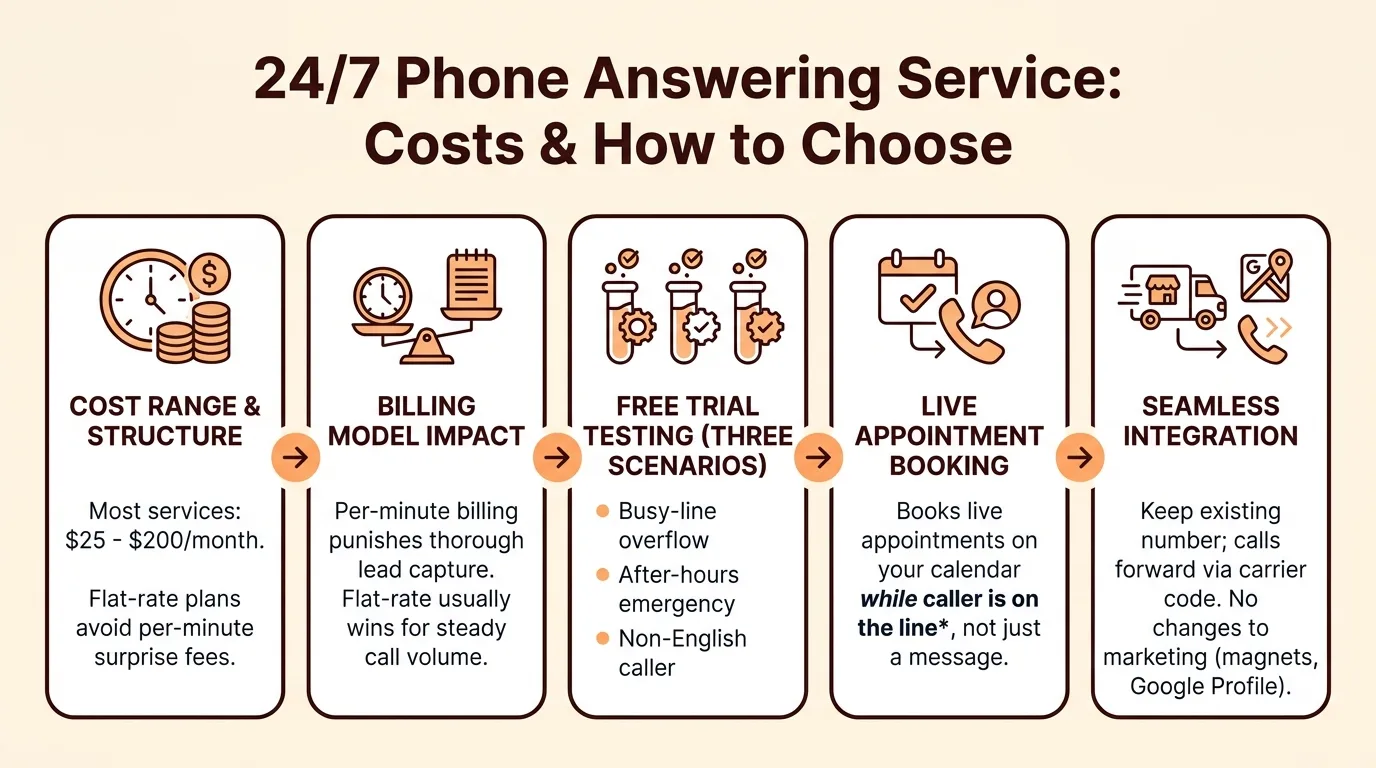
- Most 24/7 phone answering services for small trade businesses cost between $25 and $200 per month, with flat-rate plans avoiding per-minute surprise fees.
- Per-minute billing punishes thorough lead capture questions, so flat-rate plans usually win for steady call volume.
- Test three failure scenarios on a free trial before committing: busy-line overflow, an after-hours emergency call, and a non-English caller.
- A good service books appointments live on your calendar while the caller is still on the line, rather than taking a message you read too late.
- You keep your existing business number; calls forward to the service via a carrier code, so nothing on your truck magnets or Google Business Profile changes.
A 24/7 phone answering service takes every call you miss while on a job, after hours, or when your line is busy, takes a message, books appointments, or warm transfers urgent callers to you, so you never lose a job to voicemail. Expect $25-$200/mo for AI services, more for human ones. This guide breaks down the real cost math, the failure scenarios worth testing, and the questions to ask before you sign.
What is a 24/7 phone answering service and how does it actually work?
A 24/7 phone answering service picks up every call your business misses, any hour, so a customer never hears a busy tone or voicemail while you're under a sink or up a ladder. Most services for small trades run $25-$200 per month depending on call volume and features, though exact pricing varies by provider and billing model.
Call forwarding: how your calls reach the service
You keep your number. Calls are forwarded to the service when your line is busy, you don't answer within a set number of rings, or after hours. Setup is usually a forwarding code from your carrier, so there's no new number for customers to learn.
What happens on a typical answered call
The agent or AI greets the caller with your business name, finds out what the job is, captures the caller's name, address, and callback details, and either books appointments or takes a message. Urgent calls can trigger a warm transfer to your cell. At SaaSyVoice, for example, every answered call is transcribed and texted to you as a lead capture summary.
Human agents vs AI agents: which should your business choose?
Human services like Ruby Receptionists or Smith.ai charge more but handle nuance well. AI services like Goodcall, Dialzara, and SaaSyVoice answer instantly, work around the clock without per-minute surprise bills, and cost less, though they can stumble on unusual requests. For a plumbing or HVAC call, SaaSyVoice's AI answering service for plumbers shows how an AI handles job-type triage specifically.
How much does a 24/7 phone answering service cost?
Most 24/7 phone answering services fall between $29 and $199 a month for a small trade business, but the sticker price hides how you're billed. The three common models are per-minute, per-call, and flat-rate, and the cheapest headline number is often the most expensive at the end of the month.
Per-minute vs per-call vs flat-rate pricing
Per-minute billing charges for every second the receptionist is on the line, including hold time. Per-call billing charges a set amount per answered call regardless of length. Flat-rate gives you a monthly plan with a call allowance, so you know the bill before it arrives.
Worked example: 60 calls a month at three price models
These figures are illustrative, not quotes. Assume 60 calls a month averaging 3 minutes each.
| Model | Rate | Monthly cost | Surprise risk |
|---|---|---|---|
| Per-minute | $1.20/min | $216 | High, overage fees |
| Per-call | $3.50/call | $210 | Medium, long calls cost more |
| Flat-rate | $99/mo plan | $99 | Low, capped billing |
A flat-rate plan like SaaSyVoice's $29 entry tier is why flat-rate usually wins for steady call volume.
Where per-minute surprise charges hide
Watch for setup fees, charges for messages taken instead of calls answered, holiday surcharges, and overage rates above your plan. Human services like Smith.ai and Ruby Receptionists bill on usage tiers, so ask what happens when you exceed them. AI services such as Goodcall, Rosie, Dialzara, and SaaSyVoice avoid per-minute billing entirely, which is why the same restaurant chain that books tables through SaaSyVoice's restaurant answering service pays the same flat rate in July as in December.
What features separate a good answering service from a bad one?
Most services can answer a phone. The difference shows up in what happens next: whether the caller becomes a booked job or a message nobody reads until tomorrow.
Lead capture and appointment booking
A good service asks for the address, the symptom, and the urgency, then books the appointment on your calendar while the caller is still on the line. A bad one takes a message and emails it to you, which means you're calling back a homeowner who already found another plumber. Pricing models matter here too: per-minute billing punishes the thorough questions that capture better leads, so check whether a provider charges flat monthly tiers instead. The Quo buyer guide breaks down per-minute versus per-call versus flat-rate pricing and what each does to your bill (quo.com). SaaSyVoice (AI Answering Service for Small Business) books appointments directly and runs flat tiers from $29 to $199 a month, with no per-minute surprise. Where it's thinner than rivals: it won't handle complex dispatching across a multi-crew schedule the way a staffed service like Ruby Receptionists can.
Bilingual and multilingual answering
If you serve any Spanish-speaking customers, ask the provider directly whether Spanish calls are answered natively or routed to a callback. Some services treat Spanish as an add-on tier; others, including SaaSyVoice and Dialzara, answer in multiple languages on every plan.
Warm transfers and escalation rules
For genuine emergencies, a burst pipe at 2 a.m., you want a warm transfer: the service reaches you live, introduces the caller, and stays on until you pick up. Test this before committing. A service that only texts you "urgent call" and hopes you see it hasn't solved after hours.
Which failure scenarios should you test before you commit?
Any service can handle a clean 2pm call. The ones that earn your money are the calls that go wrong, so run these three tests on a free trial before you pay anyone.
The busy tone and overflow test
Call your own line while it's already on a call. If the service only forwards calls it "catches," you'll still get a busy tone and lose the job. Ask exactly how overflow works: does every call ring through, or only when a line is free?
The after-hours emergency call test
Call at 11pm pretending your water heater is flooding. A good service flags emergencies and gets them to you fast; a bad one takes a message you won't read until morning. Decide what "urgent" means for your trade and make the service follow it.
The non-English caller test
Have a Spanish-speaking friend call. If the service can't book appointments in that language, you're losing customers a bilingual competitor will take. SaaSyVoice answers in any language, and our HVAC answering setup shows how after-hours and overflow rules work in practice.
How do you calculate the ROI of never missing a call?
Run the math with your own numbers, not a vendor's. Estimate your monthly missed calls, your close rate on answered calls, and your average job value. If you miss 40 calls a month, close 30% of them, and average $300 per job, that is $3,600 in lost work, far more than any plan in the $25-$200 range most buyers evaluate.
Do the same check on per-minute billing. Some providers charge by usage, so a busy month brings a per-minute surprise; others, like Goodcall, advertise flat monthly plans instead. SaaSyVoice starts at $29/month, so if the math above holds, the service pays for itself with one saved job. The same logic holds for any appointment-based business, from caterers and event services to solo trades.
Be honest about the downside: an answering service books the job, but you still have to show up and do the work. ROI only counts jobs you can actually fit into the schedule.

What questions should you ask before signing a contract?
Ask these before you give a card number:
- What happens when the service can't answer a question? Does it take a message, warm transfer to your cell, or hang up?
- How is billing counted? Per-minute pricing is where the surprise lives. Ask what the average call length looks like for a trade business and what overage costs.
- Can I keep my number? Porting out should be possible if you ever leave.
- What's the cancellation term? Month-to-month beats an annual lock-in while you test.
- Can I hear my own calls? Recordings and transcripts let you check whether jobs are actually being booked.
Honest note on us: SaaSyVoice is month-to-month with a free trial, no credit card, but our AI won't handle every oddball call perfectly. Listen to the recordings from week one and judge for yourself.
How do you migrate your call flow to an answering service without losing customers?
Keep your number, change where it rings
You keep the number customers already have. Porting is optional; most providers, including SaaSyVoice (plans run $29–$199/mo per its pricing page), can answer calls that forward from your existing line, so nothing on your truck magnets or Google Business Profile changes. Set conditional forwarding so calls reach the service only when you miss or decline them, and test it from a second phone before your first job of the day. Run both paths for a week: check that after-hours calls, busy tones, and declined calls all route correctly. If a warm transfer is part of your setup, confirm it works on your cell, not just the office line.
Announce the change to repeat customers
Repeat customers notice a new voice, so tell them first. A text or email saying "we now have 24/7 answering, press 0 to reach me" prevents the "who is this?" hang-up. Record your greeting with your business name and a line about emergencies, so callers trust they reached the right shop.
How do the main providers compare for a small trade business?
The field splits into two camps. Human-staffed services like Ruby Receptionists (callruby.com) and Smith.ai (smith.ai) charge more because real receptionists take the call. Voice AI services like Goodcall (goodcall.com), Rosie, and Dialzara answer automatically, which keeps monthly costs in the range a solo crew can justify. SaaSyVoice sits in the AI camp, built for trades: 24/7 answering, lead capture, appointment booking, warm transfer, and your existing number, with tiers from $29 to $199 and no per-minute surprise.
Where SaaSyVoice falls short
An AI voice cannot handle a panicked caller the way a trained human can, and it will not take payment or triage a complex emergency dispatch the way Smith.ai's staffed service does. If your call volume is heavy with upset customers or unusual requests, a human service earns its higher price. If most calls are "are you available Tuesday," AI wins on cost and speed of pickup.
FAQ
Do after-hours phone answering service jobs use real people or AI, and does it matter for my customers?
Both exist. Human-staffed services like Ruby Receptionists and Smith.ai handle nuance and upset callers better; AI services answer instantly at a flat monthly cost. For most trade calls, such as asking whether you are available Tuesday, customers cannot tell the difference. If your calls involve panicked or unusual situations, a human earns its higher price.
Can I keep my existing business phone number when I switch to a 24/7 phone answering service?
Yes. You keep the number customers already have; most providers answer calls that forward from your existing line using a carrier forwarding code. Porting is optional and should be possible if you ever leave, so nothing on your truck magnets or Google Business Profile changes. Test forwarding from a second phone before your first job of the day.
Is there a free trial with no credit card required for an AI answering service?
Some offer one. SaaSyVoice, for example, runs month-to-month with a free trial and no credit card. Whatever provider you pick, use the trial to run the failure tests: an after-hours emergency call, a busy-line overflow call, and a Spanish-language call, then listen to the recordings before paying.
Will an answering service book appointments directly into my calendar, or just take a message?
A good service books the appointment on your calendar while the caller is still on the line, capturing address, symptom, and urgency. A bad one takes a message and emails it, which means calling back a homeowner who already hired someone else. Ask specifically whether booking happens live or whether you get a message.
How many minutes of answering time does a typical plumbing or HVAC call use?
Plan on roughly three minutes per call for a typical trade call: greeting, job details, address, and callback information. That matters for billing: at 60 calls a month, three minutes each is 180 minutes, which is why per-minute plans can cost double a flat-rate plan by the time the bill arrives.