
24 7 Answer Service: What It Costs and How to Pick One
Key takeaways
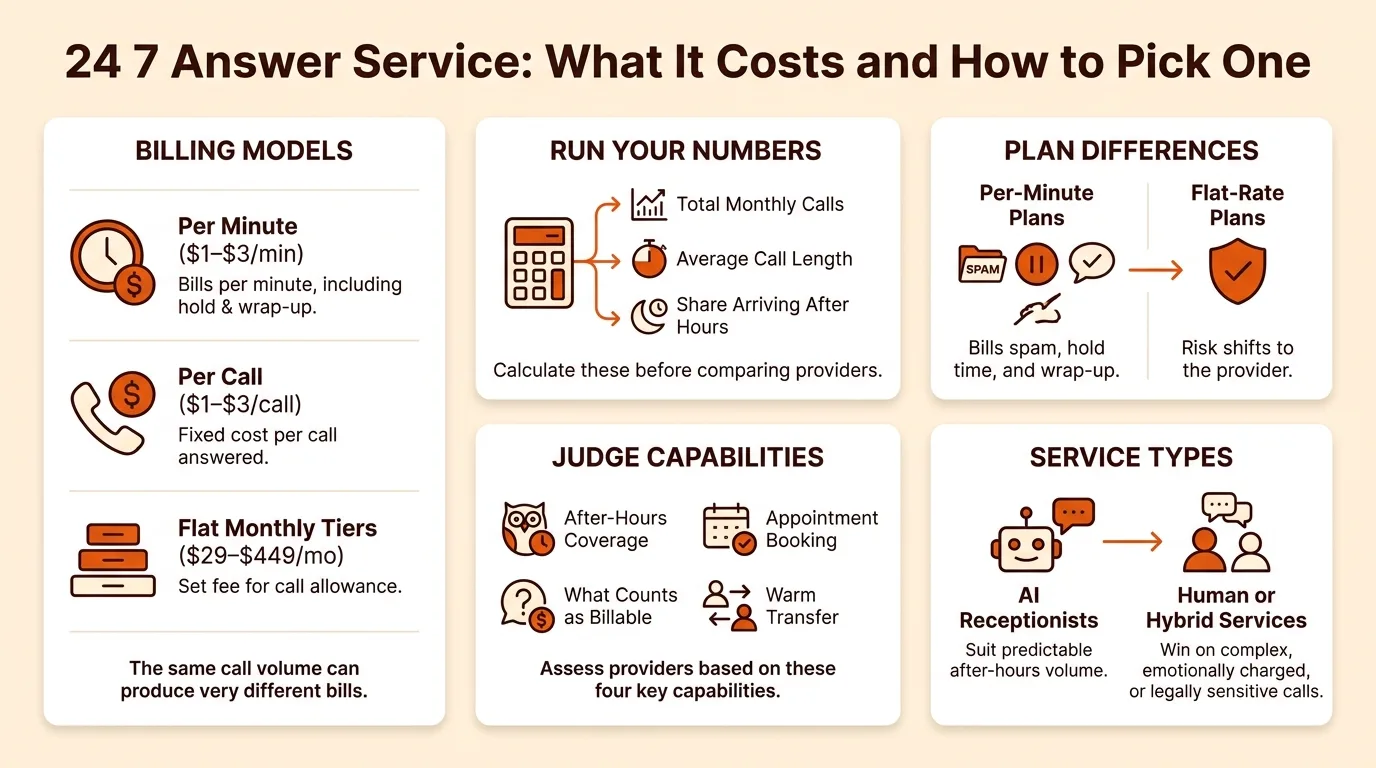
- A 24 7 answer service bills per minute ($1–$3/min), per call ($1–$3/call), or flat monthly tiers ($29–$449/mo), so the same call volume can produce very different bills.
- Run your own numbers before comparing providers: total monthly calls, average call length, and the share arriving after hours.
- Per-minute plans bill spam, hold time, and wrap-up, while flat-rate plans shift that risk to the provider.
- Judge providers on four capabilities: after-hours coverage, appointment booking, what counts as billable, and warm transfer.
- AI receptionists suit predictable after-hours volume; human or hybrid services still win on complex, emotionally charged, or legally sensitive calls.
A 24 7 answer service picks up every call you can't, after hours, on a job, or mid-repair, so missed calls stop costing you jobs. This guide shows how these services work, then walks you through pricing your own monthly cost from your real call volume under per-minute, per-call, and flat-rate billing, with a worked example for a solo HVAC contractor.
What is a 24/7 answer service and how does it work?
A 24/7 answer service picks up every call your business can't, nights, weekends, and while you're under a sink. When you're the dispatcher, the tech, and the front desk, a missed call is a missed job: a caller who reaches voicemail often calls the next business on the list.
What happens when a call comes in after hours
You forward your business line to the service. The receptionist answers in your company's name, asks what the caller needs, and follows your script: capture name, number, and the problem, then either take a message, text you the details, book an appointment on your calendar, or perform a warm transfer if it's an emergency.
Human receptionists vs AI receptionists
Human services like Smith.ai or Ruby Receptionists staff real people around the clock. AI receptionists, like the one SaaSyVoice builds from your website in about a minute (saasyvoice.ai), answer instantly, cost less per call, and never put a caller on hold. The tradeoffs come later in this guide.
What's the difference between a 24/7 call answering service and a 24/7 phone answering service?
For your purposes, nothing. Both terms describe the same thing: a service that picks up every call you can't, around the clock. Vendors use "call answering" and "phone answering" interchangeably, so don't pick a provider based on which phrase it uses. Judge it on what happens after the pickup.
Features that separate providers
Four capabilities matter to a trades owner. Message taking is the floor: the caller's name, number, and what's wrong. Appointment booking means the caller hangs up with a slot on your calendar, not a promise you'll call back. Emergency triage means the service flags burst pipes or no-heat calls as urgent so you can decide whether to roll out. Warm transfer means a real caller reaches you live when you're available.
Most AI receptionists, including SaaSyVoice, cover the first two out of the box, and SaaSyVoice includes live transfer to your cell on every plan. Check our after-hours answering service for how we handle urgent calls. Human services like Ruby Receptionists typically include transfers; ask any provider exactly which of the four you get at each price tier.
How much does an answering service cost per month?
Most 24/7 answer services bill one of three ways: per minute of talk time, per call answered, or a flat monthly tier. Typical ranges run from about $1 to $3 per minute, $1 to $3 per call, or $50 to $500 per month depending on volume and whether a human or an AI receptionist picks up. Pricing pages from providers like Smith.ai, Ruby, Goodcall, and PATLive show all three models are live in the market today.
Per-minute billing
You pay for every minute a caller is on the line, including hold time and wrap-up. A five-minute after-hours call costs five minutes of credit. Watch for minimum per-call charges and whether you pay for spam and robocalls too.
Per-call billing
You pay a flat rate per answered call, no matter how long it runs. This favors long calls, like a homeowner describing a flooded basement in detail, and punishes short ones. Check whether a "unique caller" counts once per night or once per call.
Flat-rate monthly tiers
You pay a fixed monthly price, often with unlimited minutes or a capped number of calls. This is the easiest to budget. Illustrative example of the three models:
| Billing model | Typical range | Best when |
|---|---|---|
| Per-minute | $1–$3/min | Calls are short and rare |
| Per-call | $1–$3/call | Calls run long |
| Flat tier | $29–$449/mo | Steady after-hours volume |
SaaSyVoice uses flat tiers from $29 to $449 a month with no per-minute overage, and builds your receptionist from your website in about a minute. Our AI answering service for plumbers page compares that with a traditional answering service.
How do you calculate your own answering service cost per month?
Pull three numbers from your phone bill or call log: total calls per month, average call length, and the share that come in after hours. Then run them against each billing model you're considering.
Worked example: solo HVAC contractor
Say you get 120 calls a month, averaging 3 minutes, with 60% after hours. Under per-minute pricing at a typical $1–$2 per minute, that's roughly 360 billable minutes, or $360–$720 monthly. Under per-call pricing at $2–$5 per call, you'd pay $240–$600. A flat-rate plan might run $199: on SaaSyVoice, 360 minutes fits inside the $199 Business plan's 800 minutes. Same call volume, three very different bills, which is why you need your own numbers before comparing providers.
Hidden costs that break per-minute math
Per-minute billing punishes the calls you actually want. A long after-hours emergency call that books a $2,500 job costs the same minutes as a rambling wrong number, and spam calls eat your budget too. Per-call pricing hides a different trap: repeat callers. One customer who calls three times in a week counts as three calls, not one unique caller.
Flat-rate plans shift that risk to the provider, but check whether "unlimited" caps you at a fair-use number. At SaaSyVoice, our published tiers start at $29, and the same math applies: if your volume is low and calls run short, per-minute can win; if you take heavy after-hours traffic, flat-rate usually does. (The same volume math works for appointment-heavy shops like restaurants, which is why we also run a dedicated AI answering service for restaurants.)
What should an answering service pricing comparison actually compare?
Criteria checklist
Price per minute or per call is the headline, but four things decide whether you keep the job or lose it:
- After-hours coverage — nights and weekends are when a homeowner with a burst pipe calls.
- Booking ability — can the service put the appointment on your calendar, or does it just take a message?
- What counts as billable — per-minute plans bill spam and hang-ups; per-unique-caller or flat-rate plans do not.
- Warm transfer — for a true emergency, can the caller reach you live?
Filter spam before it eats your minutes: the FTC explains how to block robocalls and scam calls and most carriers offer free screening.
How Smith.ai, Ruby, Goodcall, PATLive, and SaaSyVoice compare on the same criteria
Smith.ai and Ruby are human-staffed services with warm transfers; PATLive is a long-running human service; Goodcall and SaaSyVoice are AI receptionists. SaaSyVoice builds from your website in about a minute, books appointments, transfers urgent callers live to your cell, and answers after-hours on flat-rate tiers ($29–$449) with no per-minute overage. The honest trade-off: AI handles routine booking and after-hours capture well, but for a complex emergency call, a human service like Ruby gives a warmer touch. The same logic applies to niche setups — see how this works for event businesses.

When does an AI receptionist beat a human answering service (and when it doesn't)?
An AI receptionist wins when your calls are predictable: after-hours emergencies that need triage, appointment booking, and pricing questions your website already answers. For a plumber or HVAC shop, that is most of the volume. An AI answers instantly on the first ring, every ring, at a flat rate, while a per-minute human service charges you to listen to a customer describe a dripping faucet. Pure-AI also makes sense for salons and spas, where calls are mostly "what's your next opening?"
A human or hybrid service still makes sense when calls are legally sensitive, emotionally charged, or need judgment the script can't cover, or when you want a person to pick up when you can't. Smith.ai and Ruby Receptionists compete on that human layer.
Where SaaSyVoice falls short
We don't offer human backup: the AI can transfer a caller to your cell on every plan, but if you can't pick up, no person takes over. And an AI can mishandle an angry caller where a trained receptionist would de-escalate. If half your calls are complex insurance or warranty disputes, start with a hybrid service, not us.
How do you stop spam and robocalls from eating your answering minutes?
Spam calls bill exactly like real ones on per-minute plans, so filter them before they reach the service. Three layers work well: carrier-level blocking, call-screening at the receptionist, and your own forwarding setup.
Start at the carrier. When you forward your line using star codes (like *72 to turn forwarding on and *73 to turn it off), the same carrier tools that flag suspected spam on your phone usually still apply, though behavior varies by provider. Check the call forwarding basics on Wikipedia for how the codes work, then confirm with your carrier what filtering survives the forward.
Second, ask your provider whether suspected spam is answered, screened, or hung up on. With SaaSyVoice, a number already caught as spam is blocked before the call is answered, so a repeat robocall uses no minutes, while some per-minute services bill every second of a robocall. Third, review the call log weekly: a spike of 30-second calls at 2 a.m. is usually spam, not customers, and it's worth a plan change.
How do you set up a 24/7 answer service in one afternoon?
Setup is mostly call forwarding plus a handful of rules. With SaaSyVoice, we build your receptionist from your website in about a minute; the rest is your phone settings and your judgment calls.
Forwarding codes and service-area filtering
Dial your carrier's forwarding code (typically *72 on most US landlines, with carrier-specific codes for conditional forwarding that only kicks in when you miss a call) and point it at your service number. Conditional forwarding is the better default: you keep answering your own cell during work hours, and the receptionist only catches what you miss, including every after-hours call.
Then set your service-area filter. List the ZIP codes or towns you actually drive to, so a caller from two hours away gets told you don't serve them instead of booking an appointment you'll cancel.
Test calls before you go live
Call from a number outside your contacts and run three scenarios: a routine booking inside your service area, an after-hours emergency ("no heat, house at 50 degrees"), and an out-of-area caller. Check that the emergency one reaches you by warm transfer or urgent notification, not a polite callback tomorrow. Fix the wording, retest, then leave forwarding on.
FAQ
Is a 24/7 answering service worth it for a one-person business?
Usually yes, if you're the dispatcher, tech, and front desk. A missed call on a job site is often a missed job, because the caller rings the next business on the list. Run your own numbers first: 120 calls a month at 60% after hours can mean $240 to $720 monthly depending on billing model, so compare that against what one booked job is worth.
Do answering services charge for spam or robocalls?
It depends on the billing model. Per-minute plans often bill every second a robocall stays on the line, including hold and wrap-up, so spam eats your budget. Per-call plans can also count a spam call as an answered call. Flat-rate plans shift that risk to the provider, and some AI receptionists screen suspected spam before minutes start counting. Ask each provider directly how they handle it.
Can an AI answering service book appointments directly into my calendar?
Most modern AI receptionists can, though it's not universal. The capability to check for is whether the caller hangs up with a confirmed slot on your calendar rather than a message promising you'll call back. Human services vary by plan too. Before signing, ask exactly which features you get at each price tier: message taking, appointment booking, emergency triage, and warm transfer.
What happens if the AI can't answer a caller's question?
Good systems capture the caller's name, number, and problem, then either text you the details, take a message, or flag the call as urgent so you can decide whether to respond. The weaker outcome is a vague message you find the next morning. Test this before going live: call with a question your script doesn't cover and see whether the fallback reaches you or just logs it.
How many missed calls does a small business actually get after hours?
There's no single reliable industry-wide figure, so estimate from your own call log instead. Pull total monthly calls, average call length, and the share arriving outside work hours from your phone bill or call history. For a solo trade business, that share can be substantial, since homeowners with burst pipes or no heat call nights and weekends. Your own numbers beat any published benchmark for pricing decisions.